
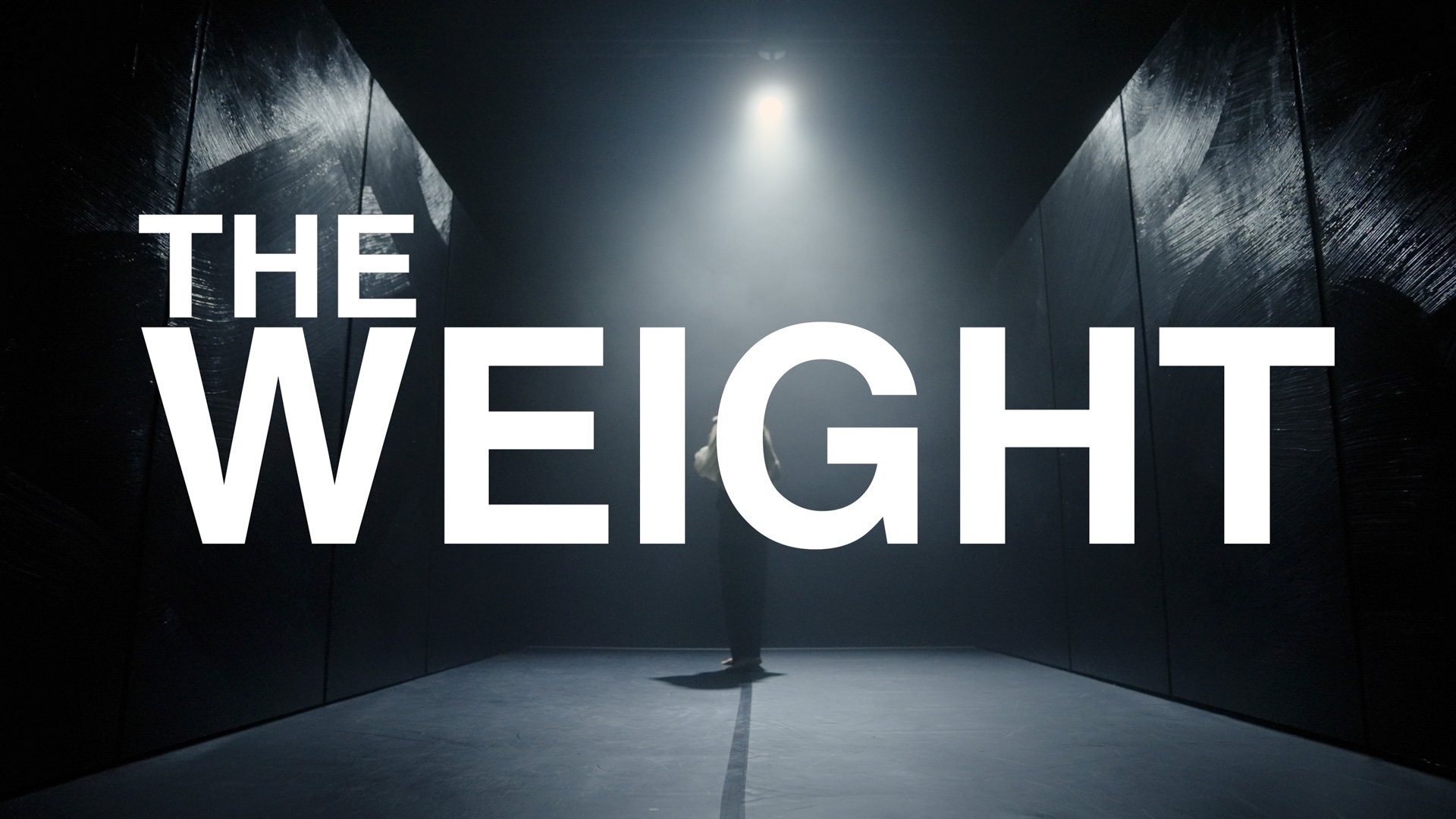







An immersive new dance work by Luca Truffarelli where ideas of freedom and subjection, the individualism of human beings and their basic human rights is reflected on.
THE WEIGHT evokes scenes from daily life, turned compelling through the gestural movements of a dance solo and the power of the orchestral score.
The production was born from Luca’s desire to creatively conjure the places and people in society so often overlooked, challenging us all to take another hard look at each other...
Against a soaring orchestral backdrop specially composed by Greg Haines and recorded with the RTÉ Concert Orchestra, this new dance collaboration by Truffarelli, was originally conceived with Oona Doherty and developed with Swiss-based dancer Erin O’Reilly.
____
CREDITS:
Creator/Director: Luca Truffarelli
Performer: Erin O’Reilly
Choreographic Collaboration: Oona Doherty, Erin O’Reilly
Composition: Greg Haines
Music recorded by The RTÉ Concert Orchestra, conducted by Gavin Maloney With brief appearances by Jessie Thompson and Saoirse Lambkin O’Kane Stage Manager: Marella Boschi
Lighting Design: Roberto Baldinelli
Lighting Associate: John Gunning
Costume Design: Valentina Gambardella
Set Design: Luca Truffarelli, Stefano & Roberto Baldinelli, Cristina Ferretti Sound Design: Luca Truffarelli, Uriel Ireland Rabinad
____
Funded by The Arts Council Ireland - Produced by Once Off Production & Luca Truffarelli Supported by Tanztheater Wuppertal Pina Bausch & The RTÉ Concert Orchestra Development phase of THE WEIGHT supported by Dublin Dance Festival
“Hope has two beautiful daughters; their names are Anger and Courage. Anger at the way things are, and Courage to see that they do not remain as they are.” - St. Augustine (disputed)
THE WEIGHT, by Luca Truffarelli, received its world premiere in Dublin in November 2023. It would be fair to say conditions weren’t optimum. There was also some uncertainty surrounding Truffarelli. A respected photographer and film maker directing a live dance event? One co-choreographed by the exhilarating Oona Doherty, and danced by the inimitable Erin O’Reilly? What exactly was the director’s role? But the show must go on. Everything would be all right on the night. And it did, and it was. Except all right is not good enough for Truffarelli. Which brings us to the Irish Cultural Centre in Paris.
Truffarelli’s interdisciplinary THE WEIGHT inhabits the collaborative intersection of choreographer and dancer in service to a film director’s vision for a live dance event. The director presenting ideas, the dancer suggesting a physical vocabulary, the director curating, assessing, refining along with dancer and choreographer. THE WEIGHT, through the dancer’s physical presence, aspiring towards a Zen-like clap of immediacy often muted behind the screen.
While socialist politics are front and centre, aesthetically THE WEIGHT is classical in its framing and structure. Its two act diptych, with a sweeping score by Greg Haines, channels Dickens and Hugo in contrasting invisible minorities and exploited workers with those who profit from their toil. Both labouring under immeasurable weight. The rich under the weight of greed and power, the low paid worker, often migrants, under the weight of oppression and hope.
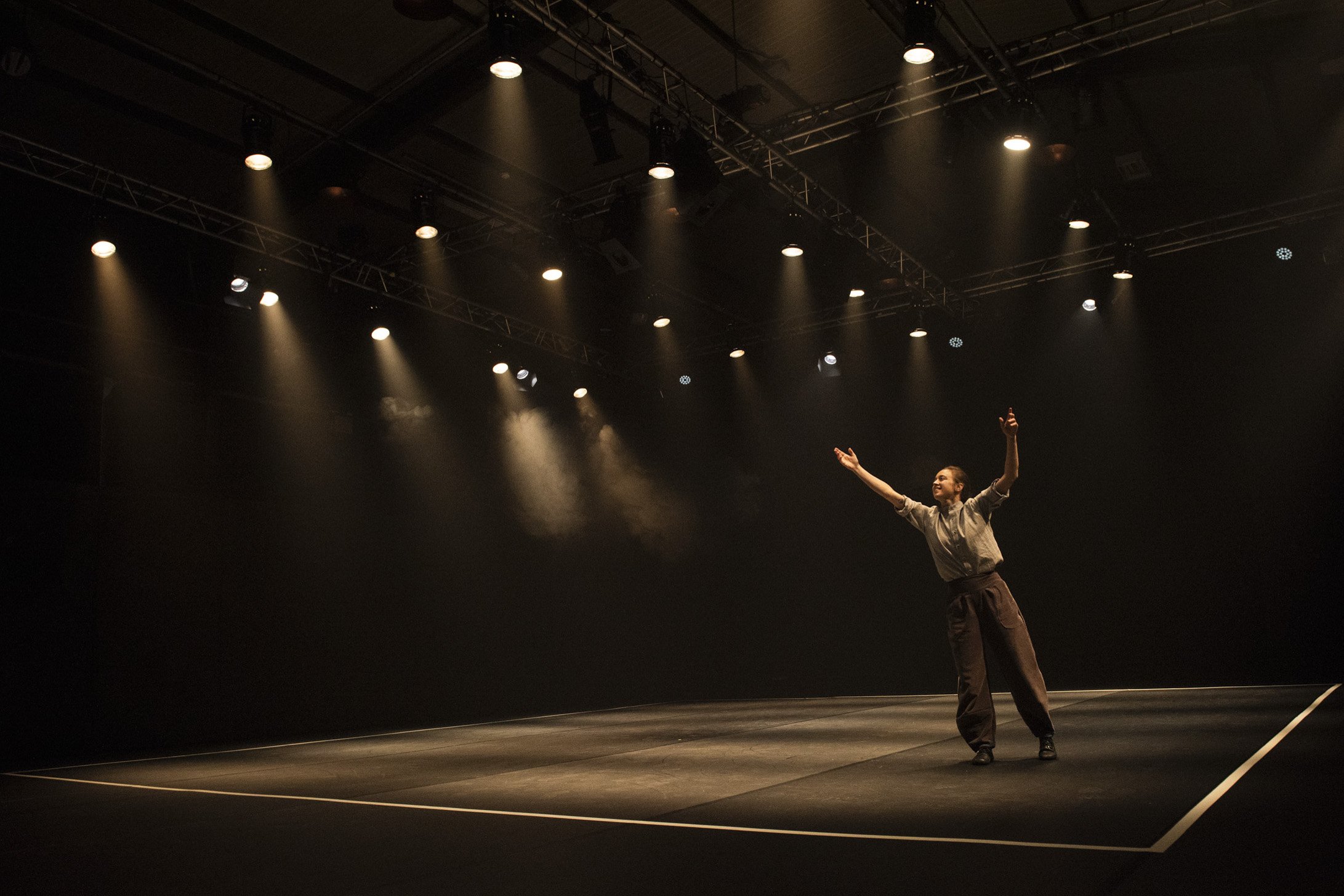
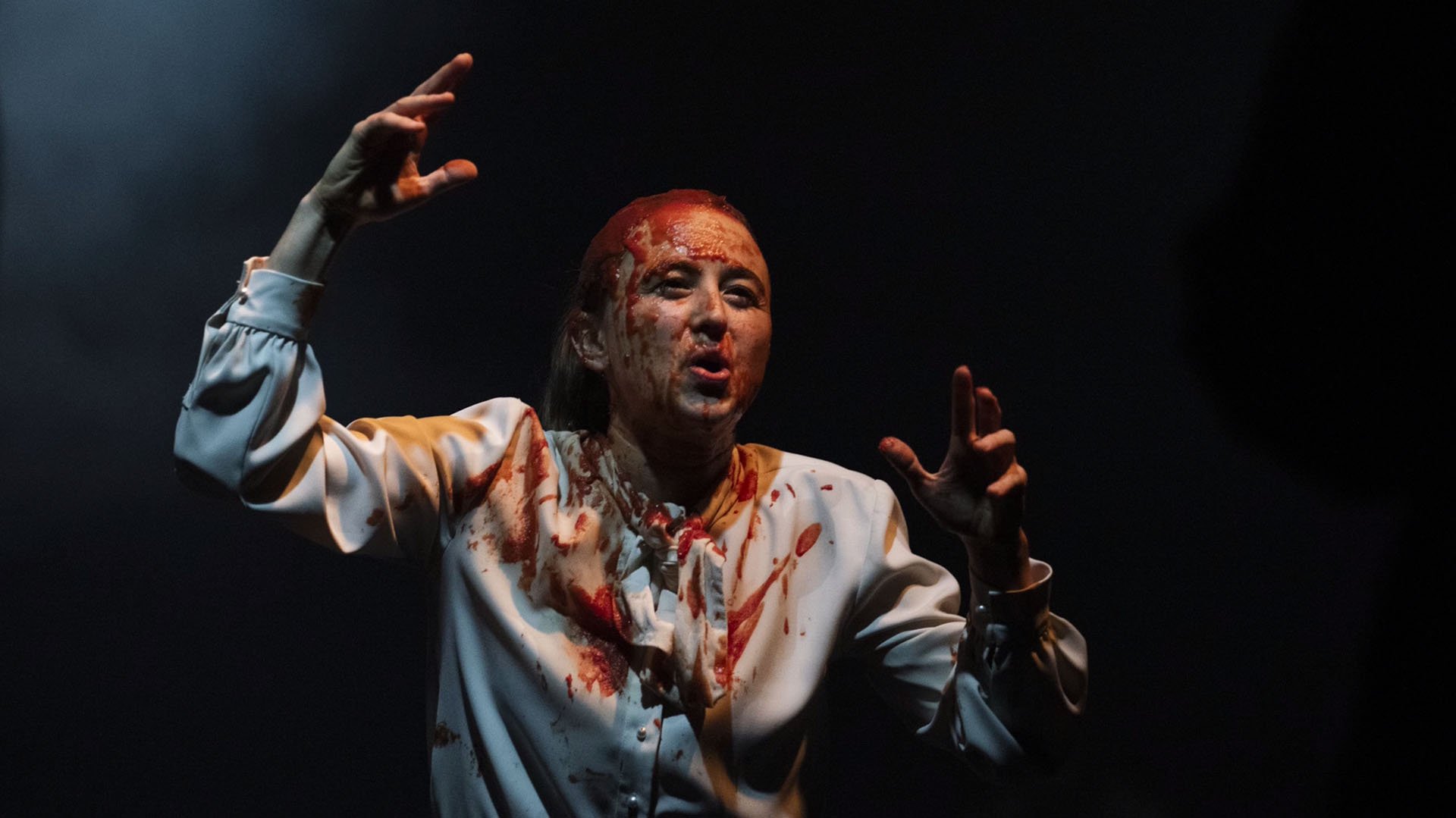
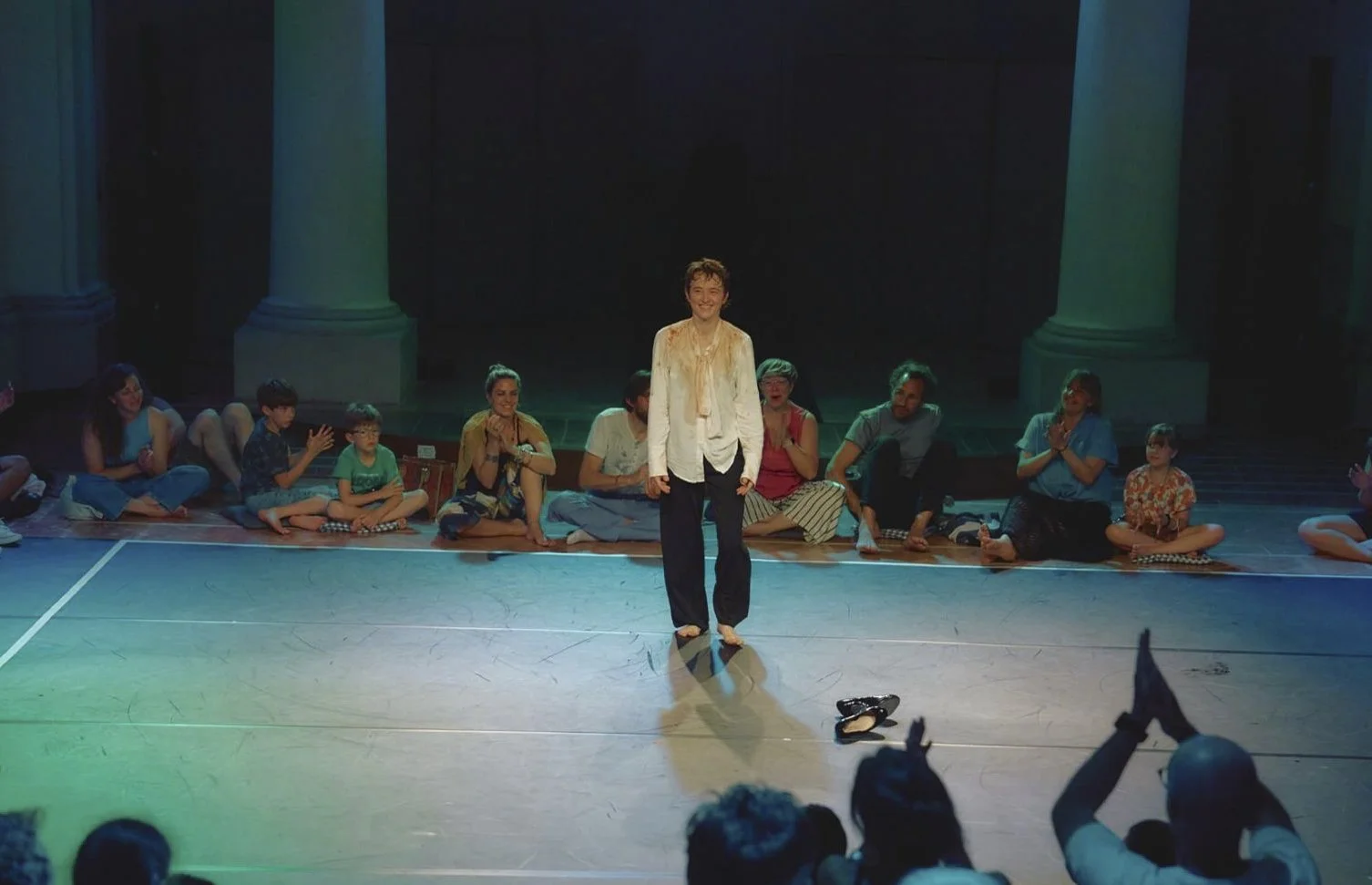
Compositionally, the audience’s relationship to dancer and space is subverted by the simple device of the round. The audience involved witnesses rather than ruminative spectators. Witnessing fear and murder as the de facto control mechanisms of an inherently violent system. One perpetuating violence through degradation and poverty. THE WEIGHT demanding we acknowledge what’s right in front of us. Especially as many choose not to. As to what’s physically in front of us, Erin O’Reilly proves luminescent in movement, gesture, and expression. Under Truffarelli’s direction her co-choreographed sequences, fashioned with Truffarelli and O’Doherty, are informed by mimetic verisimilitude at times. Simple, flung gestures reversed in juxtaposed sections telling opposing tales. O’Reilly’s Every-worker a back-broken, beast of burden replaying patterns played out along repeated lines. Her blood stained employer offering a revelation of O’Reilly as actress. The tension between individuality and freedom echoed in struggles through space and movement. O’Reilly possessing not a single, graceless bone in her body. Not a strand of hair that isn’t expressive. A glance that isn’t cavernous in its depths. Her presence visceral, seductive and mesmerising.An exposition of the abuses within the Italian tomato growing industry, cohering around the true-life assassination of trade union activist Soumayla Sacko, THE WEIGHT is also a love letter to Italy. From his mother’s voice in the opening voiceover to the final, poignant image, Italy is fused into the details. Seen from the perspective of watching someone you love destroying what’s best in themselves.
If Truffarelli is occasionally blinded by his passion for equality, and by his love of Italy, his purity of intention is infectious. Not content recognising the problems. he’s actively invested in change, with a portion of ticket sales being donated to Sea Watch. Love song and a lament, requiem for a resurrection, dancing in the dark, THE WEIGHT invites you to go deeper. Helpless, heartbroken, enraged, its pleading cries out for a better way. The weight of its hope made light by the weight of its love. The weight of doing nothing unbearable.
- Chris O’Rourke (TheArtsReview)
THE WEIGHT: REALTÀ, REITERAZIONE, ASTRAZIONE
Luca Truffarelli, perugino di origine ma da anni residente in Irlanda e attivo in un contesto internazionale, ha portato a Umbria Danza Festival uno sguardo sul corpo danzante profondamente altro rispetto alle consuetudini percettive e stilistiche cui siamo abituate e abituati.
In The Weight il corpo della magnetica Erin O’Reilly è, con spiccata sensibilità cinematografica, spesso illuminato indirettamente, raggiunto da riflessi provenienti da altri punti della scena, come una presenza che deve essere cercata, non immediatamente offerta.
Continue reiterazioni e progressive accelerazioni sottraggono alle azioni di questa vigorosa performer il loro significato quotidiano, trasformandole in puri segni, dinamiche, forze cinetiche e vocali.
La coreografia vive in questa tensione continua fra dramma e astrazione: il gesto conserva il peso simbolico della fatica, della costrizione, della sottomissione, ma contemporaneamente si libera nella pura geometria del movimento.
La musica accompagna variazioni ritmiche, crescendo e improvvisi scarti, costruendo un paesaggio emotivo instabile.
Snodo decisivo: nel buio una voce racconta lo sfruttamento dei braccianti nel Sud Italia.
Poi appare una donna, come si fosse a un elegante party: lei con la camicetta macchiata di rosso — immagine ambigua, fra sangue e alimento.
I bicchierini di pomodoro che ci sono offerti ci trasformano immediatamente in partecipi (in)consapevoli di quel sistema di sfruttamento: il consumo diventa complicità.
La performer simula l’ubriachezza, mentre la ripetizione di gesti e parole conduce ancora una volta dal riconoscibile all’astratto.
The Weight cambia di continuo codice davanti ai nostri occhi: passa dal naturalismo alla deformazione, dalla rappresentazione alla pura presenza, spostando continuamente il patto con la platea tutt’attorno.
Fra astrazione e testimonianza, la coreografia ci ricorda che lo sguardo è un luogo in cui si esercitano forze, scelte, responsabilità.
Da: “Il tempo prende corpo. Note sull’Umbria Danza Festival 2026”
Scritto da: Michele Pascarella - 8 Luglio 2026
____
Ph. Simone Rossi
2 WALLS 11mt x 2.4mt
1 CONFESSIONAL BOOTH 2mt x 2.4mt